Hands-Free Cooking Is an Accessibility Tool
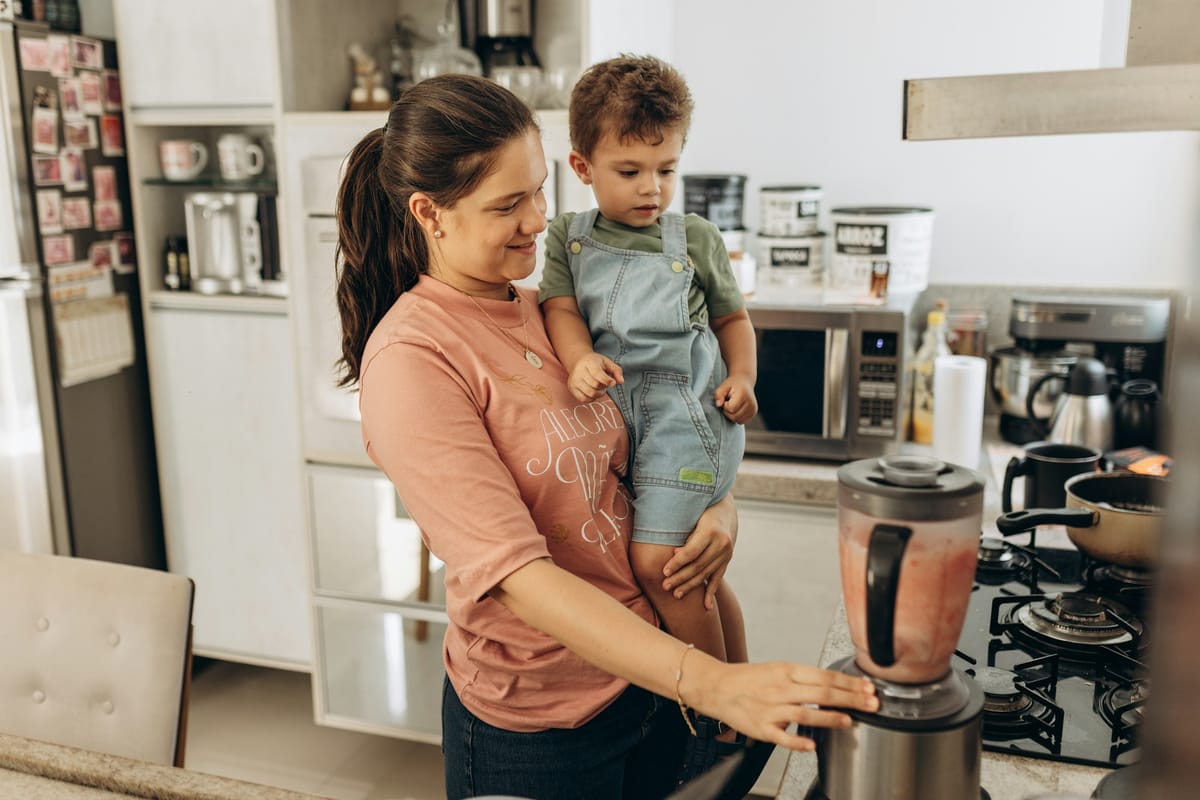
Photo by Jonathan Borba on Unsplash
The garlic has about eight seconds between golden and bitter. The next step is on a screen across the counter, and reading it means looking away from the one thing you cannot look away from. So you guess, or you look, and either way the garlic decides.
Most cooks file that moment under clumsiness. It is a design problem. And for millions of cooks it is not a moment at all. It is every time they cook.
Two Hands and a Pair of Eyes
Every recipe format we have, the printed page, the blog post, the phone propped against the kettle, makes the same quiet assumption: that the person cooking has two free, clean hands and can keep their eyes on the text. Nobody standing at a hot stove has all three. Hands are busy, sticky or holding something. Eyes are on the pan. The recipe waits politely on a screen that wants a tap.
Microsoft's inclusive design team has a useful way of seeing this. A design made for a person with one arm, their guidebook points out, "could be used just as effectively by a person with a temporary wrist injury or a new parent holding an infant." They call it the persona spectrum: permanent, temporary, situational. By Microsoft's own illustration, about 26,000 Americans a year lose an upper limb, but once you count temporary and situational impairments, the number is greater than 20 million. The kitchen is a situational impairment factory. Anyone who has stirred a risotto with a sleeping baby on one shoulder already knows this.
Not an Edge Case
For a great many cooks, though, the mismatch is not situational. According to the CDC's 2022 survey data, more than one in four American adults lives with a disability. Diagnosed arthritis alone affects 53.2 million American adults, about one in five, by the CDC's count. These are not edge cases at the margins of the cooking public. They are a large part of it, and the recipe was never designed with them in mind.
Listen to the cooks it fails most plainly. In a 2021 Carnegie Mellon study, researchers interviewed twelve visually impaired cooks about how they work, and seven raised the same worry about getting food on the tools and devices they depend on. "My hands often have oil or sauce when I am cooking my dishes," one said, explaining why neither braille nor a touchscreen recipe was easy to use mid-task. Another described a recipe that told him to cook the chicken until it turns brown and then flip it: "it is like a guessing game." A third, who has VoiceOver read recipes aloud, described losing her place in a long page and having to start again from the top. The same assumption hides in "until golden" that hides in season to taste: a faculty the recipe takes for granted. The cognitive half of this argument, the working memory a recipe quietly demands, is one we made when we wrote that ADHD cooks feel it first. This is the physical half.
The Curb Cut
In 1972, pressed by disabled activists, the city of Berkeley installed its first official curb cut, at an intersection on Telegraph Avenue. One advocate later called it "the slab of concrete heard 'round the world." As Angela Glover Blackwell wrote in the Stanford Social Innovation Review, "When the wall of exclusion came down, everybody benefited." Parents with strollers headed straight for it. So did workers with heavy carts and travellers with suitcases.
The kitchen already has a curb cut of its own. Sam Farber watched his wife Betsey, who had arthritis in her hands, struggling with an old-fashioned peeler, and set out with a design firm and a New York arthritis group to make a better one. The result was the OXO Good Grips line, launched in 1990, and its fat, soft handle is now so ordinary that most cooks never wonder who it was for.
Voice-first cooking belongs in that tradition, and it is worth being clear about the order of things. It is for the cooks who cannot look, or cannot touch, or cannot do both at once, first. In the cooking videos the same researchers analysed, blind cooks were already using Siri, Alexa and Google to set their timers. That a parent with a baby on one shoulder, or anyone with a wrist in a cast, can also cook a recipe out loud is the curb-cut effect doing what it always does. Voice is not every answer, either. A 2024 review of voice assistants in the disability community found speech interpretation among the main barriers, and a good kitchen will need more than one kind of ramp. But a recipe that can be heard, paused and asked a question, without a single tap, removes a barrier the page put there in the first place.
That is the reframe worth keeping. When a scroll-and-tap recipe beats you, with full hands or tired eyes or a body that does not do what the format expects, the format failed. You did not. It is why we built a voice-first cooking app to begin with.
Want a recipe that keeps up when your hands are full? Learn more at ChefTalk.
At ChefTalk, we're building a voice-first cooking companion that transforms any recipe into hands-free, step-by-step guidance. Learn more.
Sources
- Centers for Disease Control and Prevention (2024). Disability and Health Data System, BRFSS 2022. Age-adjusted prevalence of any disability among U.S. adults: 28.7%.
- Fallon, E. A., et al. (2023). Prevalence of Diagnosed Arthritis — United States, 2019–2021. MMWR, 72(41).
- Microsoft (2025). Inclusive 101. Microsoft Inclusive Design.
- Li, F. M., Dorst, J., Cederberg, P., & Carrington, P. (2021). Non-Visual Cooking: Exploring Practices and Challenges of Meal Preparation by People with Visual Impairments. ASSETS '21.
- Blackwell, A. G. (2017). The Curb-Cut Effect. Stanford Social Innovation Review, 15(1).
- Esquivel, P., Gill, K., Goldberg, M., Sundaram, S. A., Morris, L., & Ding, D. (2024). Voice Assistant Utilization among the Disability Community for Independent Living: A Rapid Review of Recent Evidence. Human Behavior and Emerging Technologies.
- Hunnicutt, R. (2015). Getting a Grip on User-Inspired Design. Cooper Hewitt, Smithsonian Design Museum.