Cooking Alone Is Not the Same as Cooking for One
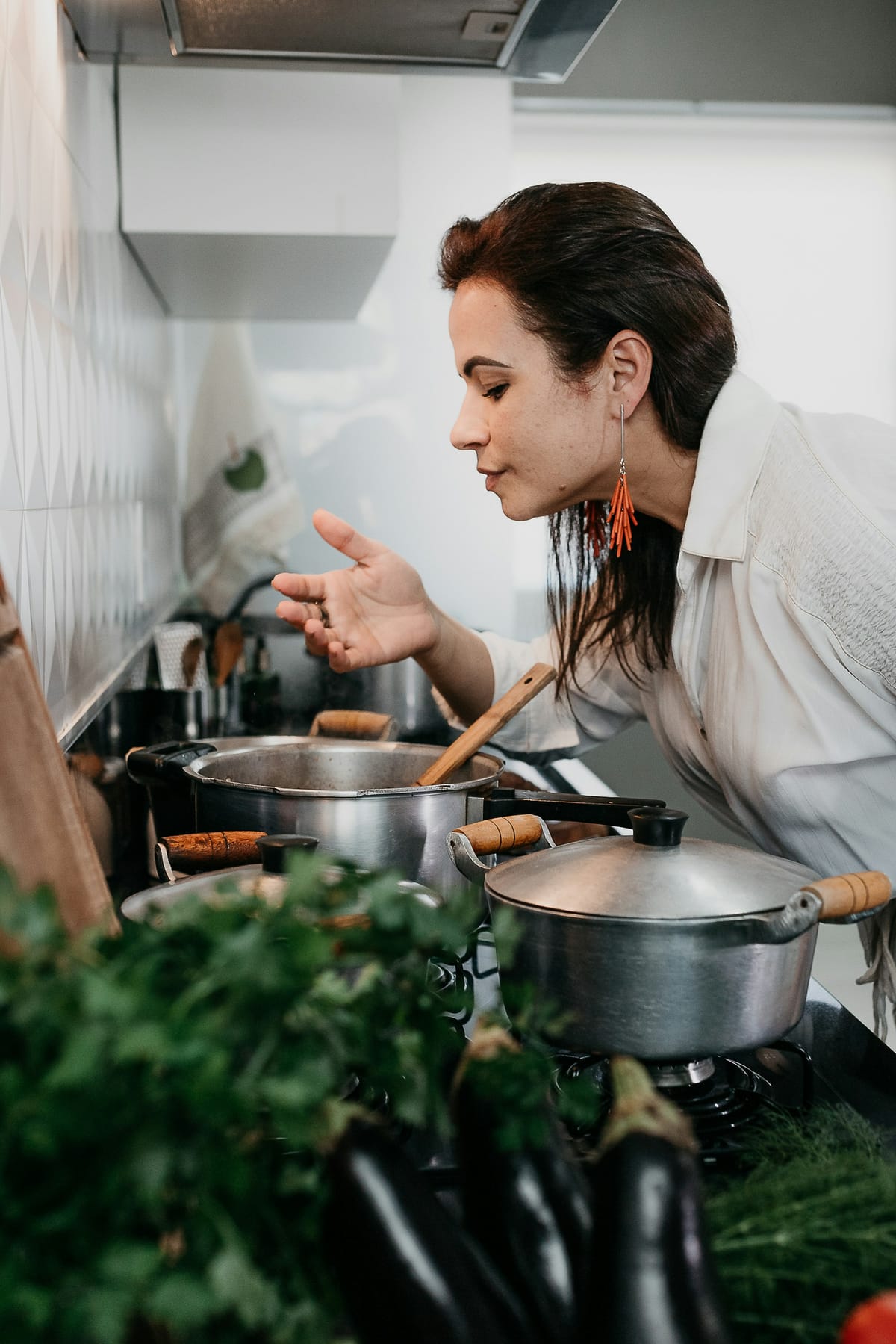
Photo by Vitor Monthay on Unsplash
The recipe makes four. You are one. So you eat what you want of it standing at the counter, spoon the rest into a container, and put it in the fridge for a Tuesday that has not happened yet.
There was nothing wrong with that dinner. It was probably good. Something about it was still flat, and the flatness is worth naming, because it is not a failure of enthusiasm and it is not a sign that you have stopped caring about food.
Cooking alone is not the same as cooking for one. Cooking for one is arithmetic: buy smaller, halve the recipe, freeze the surplus. Cooking alone is a question of audience, and no recipe has ever been written for it.
The Recipe Assumes a Table
Every recipe you have ever cooked contains an unstated guest list. It serves four, or six, or eight. It tells you to let the roast rest while you dress the salad, which only makes sense if somebody is waiting. It ends with plating, as though the food were going somewhere.
Fewer and fewer of us are that household. In its 2025 chapter on shared meals, the World Happiness Report analysed two decades of the American Time Use Survey, roughly 235,000 adults between 2003 and 2023, and found that in 2023 about one in four Americans reported eating every one of their meals alone the previous day. That is a rise of 53 percent since 2003. The Census Bureau counts 38.5 million one-person households, 29 percent of the country, against 19 percent in 1974.
The recipe has not noticed. It still opens with a number of servings that assumes a dining room, and a supermarket still sells chicken thighs in packs of six and herbs in quantities that will rot before you reach the bottom of the bunch. The format, as ever, was written for somebody else and handed to you.
The Half of Cooking Nobody Mentions
Here is the part that the portion math cannot reach.
Almost every instinct that makes someone a good home cook was trained by another person's reaction. You learn to season by watching a face. You learn how much is enough by what comes back on the plate. You learn which dish is worth repeating because somebody asked for it again. The instruction to season to taste quietly assumes not just a palate but a second one, some external standard against which your own guess gets checked.
Take that away and the mechanics of cooking survive perfectly well. The onions still soften. The timing still works. What goes is the response, and the response was never decoration. It was the feedback that told you the effort had registered somewhere outside your own head.
Playing an instrument in an empty room is the same set of notes as playing it for someone. It is not the same activity, and nobody pretends otherwise.
So the dinner you cooked for yourself was fine, and it felt like less than it was, and both things are true at once. That is not sentimentality. It is a loop that opens and never closes.
It Is Not About Living Alone
The easy reading of all this is that it belongs to single people, which would make it somebody else's article.
The same World Happiness Report analysis takes that reading apart. In 2023, roughly 18 percent of Americans who live with other people still ate every meal alone the previous day, up from 12 percent in 2003. That is a 50 percent rise inside shared households, steeper in relative terms than the rise among people who live by themselves. When the researchers ran the numbers, the growth in living alone explained only 15 to 20 percent of the growth in eating alone. Staggered shifts, separate schedules, a teenager eating at nine, one person at the table and one on the sofa with a phone: the house is full and the meal is solitary anyway.
Meanwhile, the cooking never stopped. A 2025 analysis in Current Developments in Nutrition, working from the same survey data, found that the share of American adults who prepared food on a given day rose from 53 percent in 2003 to 62 percent in 2023, with time spent cooking holding steady at about an hour.
Read those two findings together, because they are drawn from the same twenty years of the same dataset and they point in opposite directions. More people are cooking than two decades ago. Fewer people are eating with anyone. Nobody gave up on the kitchen. What thinned out was the company.
What You Are Actually Missing
If the missing thing were company, there would be nothing to do about it on a Wednesday at seven with the pan already hot. That framing leaves the solo cook with a problem and no move.
But the thing that goes missing is narrower than company, and stranger. It is response. It is the kitchen answering when you ask it something. Cooking with someone else in the house means a running commentary you barely notice until it stops: is this enough salt, how long has that been in, what was I doing before the phone rang, do you think this is done. Those are not conversation. They are the working memory and the second opinion that cooking has always borrowed from whoever was standing nearby.
Cooking alone means every one of those questions lands in the same tired head that is also chopping. It is the threshold problem again, and the format problem again, arriving this time through the door marked solitude: the cost of the meal is carried entirely by the person least able to share it.
None of which means the solution is a person. A kitchen that answers you is not a stand-in for someone to eat with, and it would be insulting to suggest it. It is something smaller and more available: a loop that closes, on the nights when there is nobody there to close it.
You cooked. It counted. The fact that nobody said so does not change what happened at the stove.
Ready for a kitchen that answers back? Learn more at ChefTalk.
At ChefTalk, we're building a voice-first cooking companion that transforms any recipe into hands-free, step-by-step guidance. Learn more.
Sources
- Helliwell, J. F., Layard, R., Sachs, J. D., De Neve, J.-E., Aknin, L. B., & Wang, S. (Eds.) (2025). Sharing meals with others: How sharing meals supports happiness and social connections. World Happiness Report 2025, Chapter 3.
- Ewoldt, J., Ng, S. W., Popkin, B. M., & Taillie, L. S. (2025). Trends in Home Cooking among United States Adults from 2003 to 2023: Analysis of American Time Use Survey Food Preparation. Current Developments in Nutrition.
- U.S. Census Bureau (2024). Nearly Two-Thirds of U.S. Households are Family Households.